





It’s hard to scroll online lately without seeing some version of this claim:
“Big investors are buying up all the homes.”
And honestly, if you’re a homebuyer who’s lost out on a few offers, that idea probably sounds believable. When homes are expensive and competition is tight, it’s easy to assume giant companies are scooping everything up behind the scenes.
But here’s the thing: what people assume is happening and what the data actually shows aren’t always the same.
Let’s look at what’s really happening with large institutional investors in today’s housing market – because the numbers tell a much different story than the headlines.
The Number Most People Won’t See Online
Let’s start with the most important stat. According to John Burns Research & Consulting (JBREC), large institutional investors – those that own 100 or more homes – made up just 1.2% of all home purchases in Q3 of 2025 (see graph below):
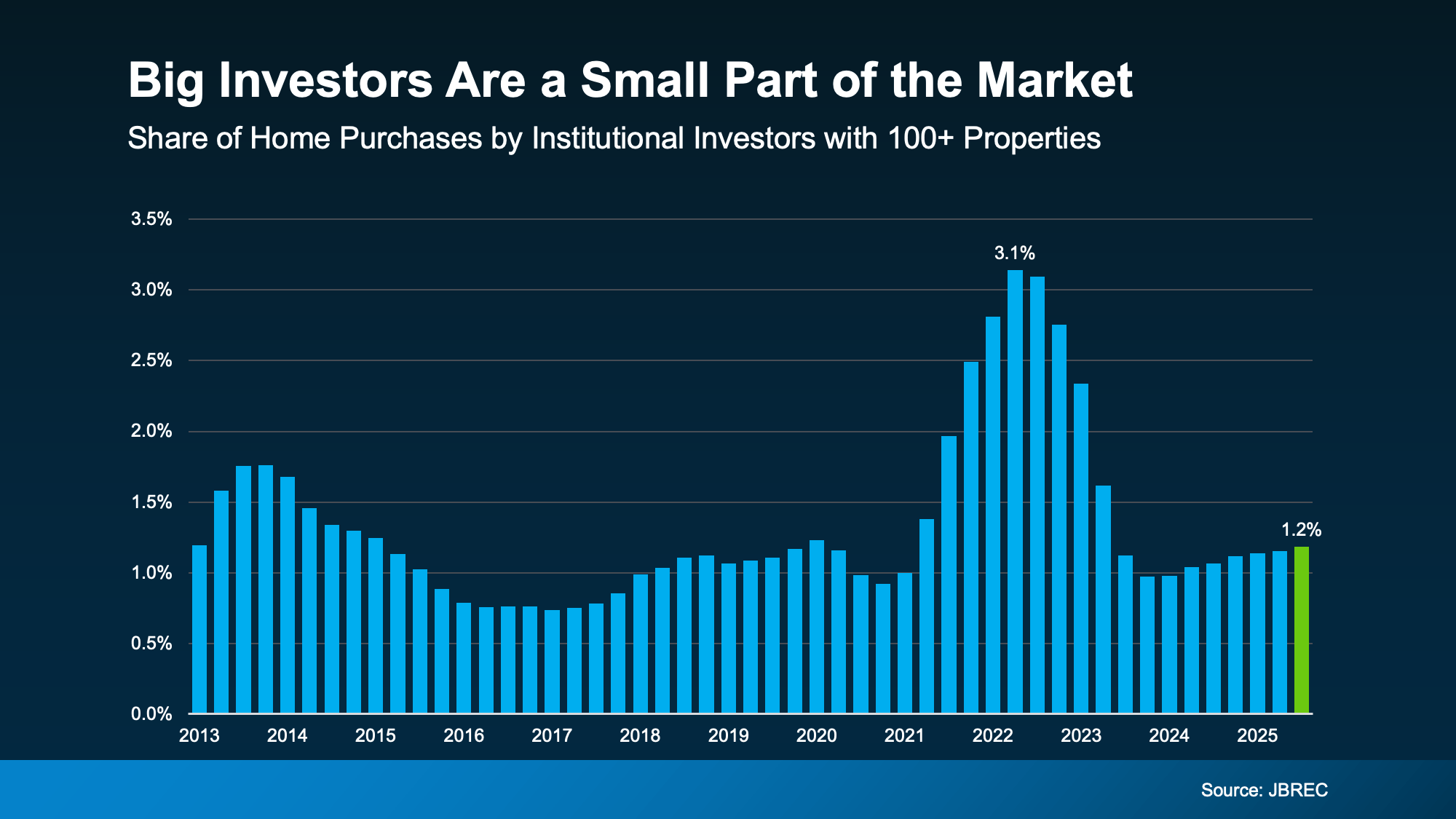 That’s it. Out of every 100 homes sold, only about 1 went to a large institutional investor.
And here’s an important point that often gets missed: that level of investor activity is very much in line with historical norms. It’s not unusually high, and it’s actually well below the recent peak of 3.1% back in 2022 – which itself was still a small share of the overall market.
So, while it can feel like big investors are everywhere, nationally, they’re a very small part of overall home sales.
Why Investor Activity Gets So Much Attention
There are two main reasons this topic gets so much attention:
- Investor activity isn’t spread evenly.Investors are more active in certain markets, which can make competition feel intense for homebuyers in those areas. As Lance Lambert, Co-Founder of ResiClub, explains:“On a national level, “large investors”—those owning at least 100 single-family homes—only own around 1% of total single-family housing stock. That said, in a handful of regional housing markets, institutional and large single-family landlords have a much larger presence.”
- Investor is a broad term.Part of what makes the share of purchases bought by investors sound so big is because many headlines lump large Wall Street institutions together with small, local investors (like your neighbor who owns one or two rental homes). But those are very different buyers.In reality, most investors are small, local owners, not massive corporations. And when all investors get grouped together in the headlines as a single stat, it inflates the number and makes it seem like big institutions are dominating the market (even though they’re not).
Yes, big investors exist. Yes, they buy homes. But nationally, they’re responsible for a very small share of total purchases – far smaller than most people assume.
The bigger challenges around affordability have much more to do with supply, demand, and years of underbuilding than with large institutions competing against everyday buyers.
That’s why it’s so important to separate noise from reality, especially if you’re trying to decide if now is the right time to move.
Bottom Line
If you want to talk through what investor activity actually looks like in our local market, and how it impacts your options (or doesn’t), connect with a local real estate agent.
Sometimes a little context makes all the difference.